layermix reads a task-runner.json with tasks and their dependencies, builds the DAG, and runs tasks in parallel up to the graph’s constraints. The same config drives three runtime modes.
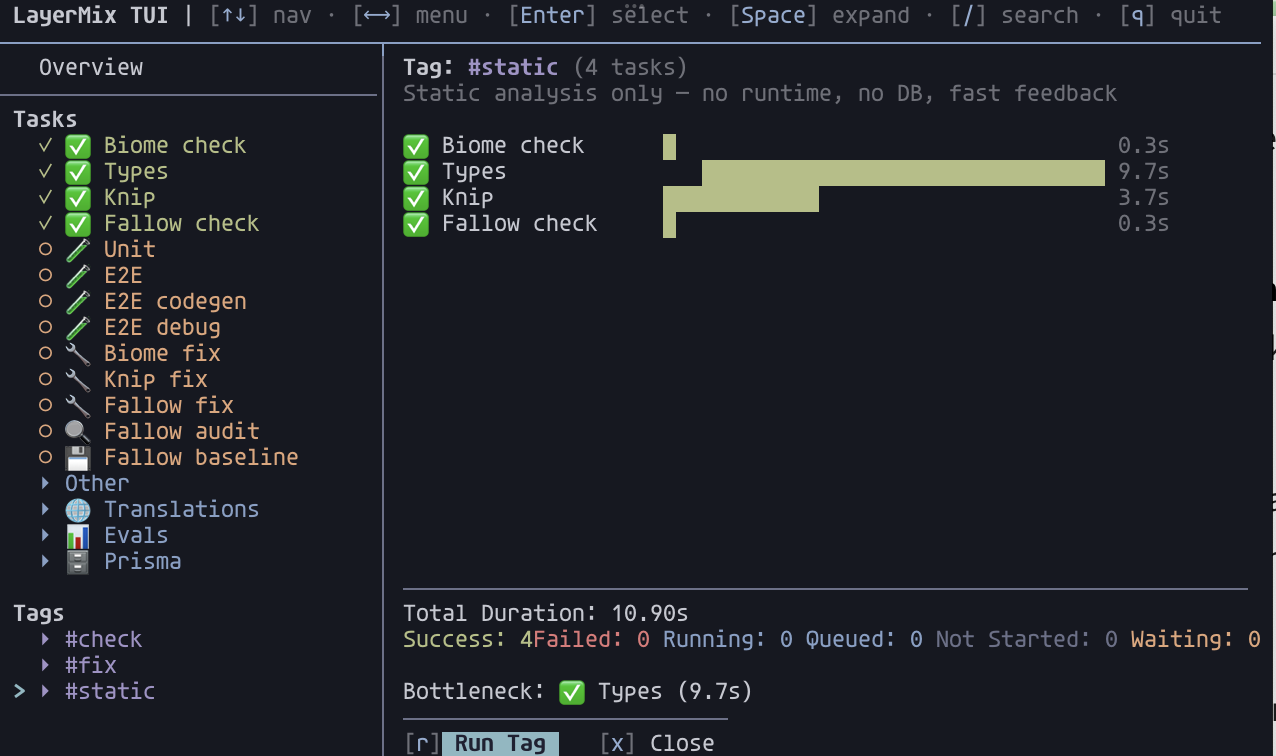
In a terminal, it launches an interactive Ink TUI. You watch status change live, retry failed tasks with a keystroke, and filter by typing /.
In CI, output is buffered per task and flushed on completion. Each task gets a [task] Starting... / Finished / Failed header block, so parallel execution never interleaves. Pass --junit <path> for a machine-readable report.
Inside Claude Code, Cursor, Aider, or Continue, the agent is auto-detected via env vars. Output drops to linear, no flags needed. --dry-run-json gives the agent the full execution plan (layered topological sort, resolved cwd and env, transitive dep closure) without spawning processes.
The same invocation works everywhere. layermix -t test means the same thing on your laptop, in GitHub Actions, and when Claude Code runs it.
Install
npm i -g @layermix/cli
# or ad-hoc
npx @layermix/cli init
Node 20+. Binary: layermix.
60-second tour
Scaffold a config:
layermix init
Replace the placeholder with your real tasks:
{
  "$schema": "https://unpkg.com/@layermix/cli@2.3.0/schema.json",
  "tasks": [
    { "id": "clean",   "cmd": "rm -rf dist",   "dependsOn": [] },
    { "id": "compile", "cmd": "tsc",           "dependsOn": ["clean"] },
    { "id": "lint",    "cmd": "biome check .", "dependsOn": [],          "tags": ["test"] },
    { "id": "test",    "cmd": "vitest run",    "dependsOn": ["compile"], "tags": ["test"] }
  ]
}
Run tasks by id. Dependencies fire automatically:
layermix compile                        # clean, then compile
layermix lint test                      # both, with max parallelism
Run every task carrying a tag:
layermix -t test
Inspect the plan without touching anything:
layermix validate                       # prints execution layers
layermix run --dry-run-json -t test     # prints JSON with layers, cwd, env, deps
Drop it in CI:
layermix -t test --ci --junit report.xml
That’s the whole idea. The rest of the docs cover the config surface, the TUI, CI and agent behaviour, and the weirder bits.
Why I built this
I kept writing the same shell glue in every project: “clean, then tsc, then in parallel run lint and test”. make works for DAGs but fights modern shell escapes. turborepo and nx are heavier than I want for a small TypeScript project. npm-run-all does parallel but not dependencies.
layermix is one JSON file and a runner that works the same on my laptop, in CI, and inside a coding agent. A few opinionated choices worth flagging:
- A bare
layermixwith no target does nothing on purpose. In CI/AI mode it exits 1, so a scheduled agent can’t silently succeed. In a terminal it opens the TUI idle. SetdefaultRunto give empty invocations a target. - Unknown task ids and tags exit 1 in every mode.
layermix tst(typo fortest) fails loudly instead of quietly succeeding. - Linear output is boring on purpose:
[task] Starting.../Finished/Failed/Skippedheaders, logs between them. Grep-friendly. - There’s no plugin system. If you need to do something, write a task that does it.
Where next
task-runner.jsonreference. Every field. Monorepo merge semantics.defaultRun. Tags vs groups.- Terminal UI guide. Layout, keybindings, search, the seven run / retry actions.
- CI and AI agents.
--ci,--ai, auto-detection, JUnit, dry-run JSON, agent skill file. - Task arguments. Parameterised tasks:
$1,$2, file pickers in the TUI,--argon the CLI. - Scenarios. Task-oriented playbook. “I want to X” to “run this”.
- CLI reference. Every subcommand, flag, exit code.
Source is on GitHub. Issues and PRs welcome.